Are AI Tattoo Designs Any Good? An Honest Look
It's a fair question, and the honest answer is: it depends entirely on how you use them. AI tattoo designs can be genuinely useful or genuinely useless, and the difference isn't the tool - it's the expectations you bring to it.
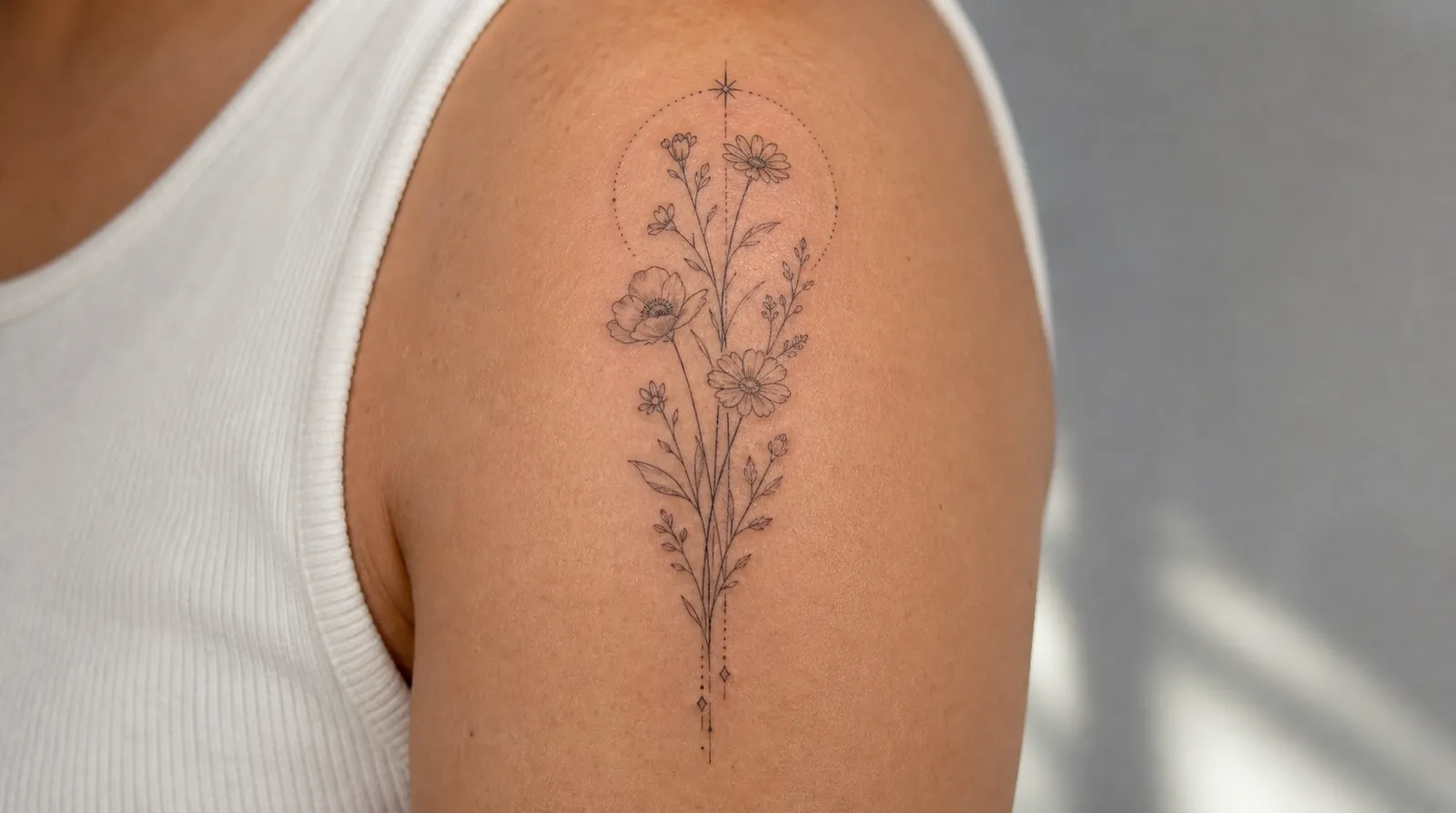
Where AI tattoo design genuinely helps
The real strength of a generator is exploration. It turns a fuzzy idea into something you can look at in seconds, which is where most people get stuck. Instead of describing a vision across a studio counter, you walk in with a picture.
- Trying a concept before committing - see a style or placement idea rendered before it's permanent.
- Breaking creative block - a few variations often reveal what you actually want.
- Communicating with your artist - a reference is worth a hundred words.
- Exploring styles you don't know how to draw - no sketching skill required.
What it handles well, and what it fumbles
Quality isn't uniform across subjects. It tracks how forgiving the subject is: things built from clean shapes and repeatable elements come out well, and things where a small error is instantly obvious to a human eye don't.
Reliably good: botanical and floral work, fine line and minimalist designs, geometric and ornamental patterns, animals rendered as illustrations rather than portraits, and most American traditional motifs - that style's whole logic is bold simplified forms.
Consistently awkward: hands and faces, anything requiring true bilateral symmetry, and text. Lettering is the one to watch - models routinely produce letterforms that look right at a glance and turn out to be subtly malformed or misspelled. If a name or a phrase is the point of the piece, use a dedicated name tattoo generator and then proofread it letter by letter, out loud, before it goes anywhere near a needle.
Where it falls short
AI is not a tattoo artist, and pretending otherwise is where people get burned. A generator doesn't understand how your specific skin will hold ink, how a design should flow around a bicep, or how thin a line can be before it disappears in five years.
It can also produce designs that look great on screen but aren't tattoo-able: too much fine detail, photographic shading no needle can reproduce, or backgrounds that would turn to mush. A generated image is also a flat rectangle - it has no opinion about how the piece should sit on a curved, moving surface, which is a large part of what you're paying an artist to decide.
The originality question, honestly
Image models learn from existing artwork, and that has a real consequence: a generated design can echo the style - occasionally the composition - of work someone else made. Every generation is produced from your prompt, so you won't get a pixel-for-pixel copy of an existing tattoo, but "statistically unlikely to be identical" isn't the same as "provably original."
For a personal tattoo this rarely matters much, and your artist redrawing it removes most of the concern anyway. It matters more if you plan to use a design commercially - as flash you'd sell, as a logo, as merchandise. In that case do a reverse image search before you commit, and get proper advice rather than taking a generator's word for it.
The other half of this is etiquette. If a generated design leans heavily on a specific, recognisable artist's style, the decent move is not to walk into a different studio and ask someone to reproduce it. Book with the artist whose work you're drawn to instead.
How to judge a design in thirty seconds
You don't need a trained eye to catch most of the failures. Run through this before you get attached to a result:
- Shrink it to the real size and squint. If it turns into a grey blob, it's too detailed to tattoo at that scale.
- Count the focal points. One is a design. Three is a collage that will fight itself on skin.
- Look at the negative space. Healthy designs have room between elements; crowded ones close up as the ink spreads.
- Check every letter, digit and symbol individually. This is where generated designs fail most often and most embarrassingly.
- Look for detail that only exists as texture - photographic gradients and hair-thin filler lines rarely survive the translation to ink.
The realistic way to use them
Think of an AI design as a mood board and a first draft rolled into one - not the final stencil. Generate to explore and to communicate, then hand the result to a professional who adapts it into something that will actually live well on your body.
Used that way, the quality question mostly answers itself. The tool gets you a strong, specific starting point; the artist gets you a tattoo worth keeping. If you're at that stage, here's what to do at the handoff.
Frequently asked
- Are AI-generated tattoo designs unique?
- Each generation is created from your prompt, so no two are identical. That said, AI learns from existing art and can occasionally echo it, so do your own checks before using a design commercially - and let your artist add their own touch.
- Can I tattoo an AI design exactly as generated?
- Sometimes, but it's smarter to treat it as a reference. A good artist will refine the linework and proportions so the design holds up as a real tattoo rather than just a nice image.
- Do tattoo artists mind AI-generated designs?
- Opinions genuinely differ. Many artists welcome a clear reference because it removes guesswork about what you want. Others have strong feelings about AI trained on artwork like theirs. Mention up front that the reference is AI-generated and that you're expecting them to redraw it - that framing is what most artists actually object to when it's missing.
- Who owns an AI-generated tattoo design?
- Ownership of AI output is unsettled and varies by country - in several jurisdictions, work without human authorship can't be copyrighted at all. For a personal tattoo it's rarely an issue. If you intend to sell or license a design, check the terms of the tool you used and get proper legal advice rather than assuming.
- Why does AI struggle with tattoo lettering?
- Image models draw letters as shapes rather than spelling words, so they produce forms that look typographically plausible but are subtly wrong - a missing serif, a doubled letter, an invented character. Always proofread generated lettering character by character, and have your artist set the final text properly.
- Is an AI tattoo design good enough for a small first tattoo?
- It's a good fit for exactly that case. Small first tattoos tend to be simple, single-subject designs in fine line or minimalist styles - the category generators handle best. Keep it simple, size it honestly, and let the artist adjust the line weight.
Put it into practice.
Describe your idea and get a clean, ready-to-ink design in seconds.
Start designing