Japanese (Irezumi) Tattoos
Irezumi is the traditional Japanese style: bold, flowing compositions built around dragons, koi, tigers and seasonal flowers, tied together with stylised wind, water and cloud. It is among the oldest tattoo traditions still practised largely unchanged - and the one carrying the most cultural weight.
A bestselling novel started it
In the 1820s, the artist Utagawa Kuniyoshi published a series of woodblock prints illustrating the Suikoden - a wildly popular Chinese outlaw epic - and drew its heroes covered in sprawling tattoos.
The prints were a sensation, and Edo went tattoo-mad. Firefighters, labourers and couriers began wearing full body suits modelled on Kuniyoshi's warriors. The visual language of Japanese tattooing was essentially set in that moment: the motifs, the flowing backgrounds, the way a piece wraps a torso. Modern irezumi still runs on it.
Then the state turned on it. Tattooing was banned in the Meiji era as Japan remade its image for the West, and stayed illegal until 1948. Driven underground, it picked up an association with organised crime that it has never fully shaken - which is why, to this day, many Japanese onsen, gyms and pools still refuse entry to visibly tattooed people. If you're getting a large Japanese piece, that's worth knowing before you travel rather than at a bathhouse door.
The motifs and what they carry
Japanese tattooing is a language, not a mood board. These subjects have carried consistent meaning for two centuries, and choosing one means saying something specific.
- Dragon - wisdom, strength and protection. In Japanese tradition a benevolent force, closer to a guardian than a monster.
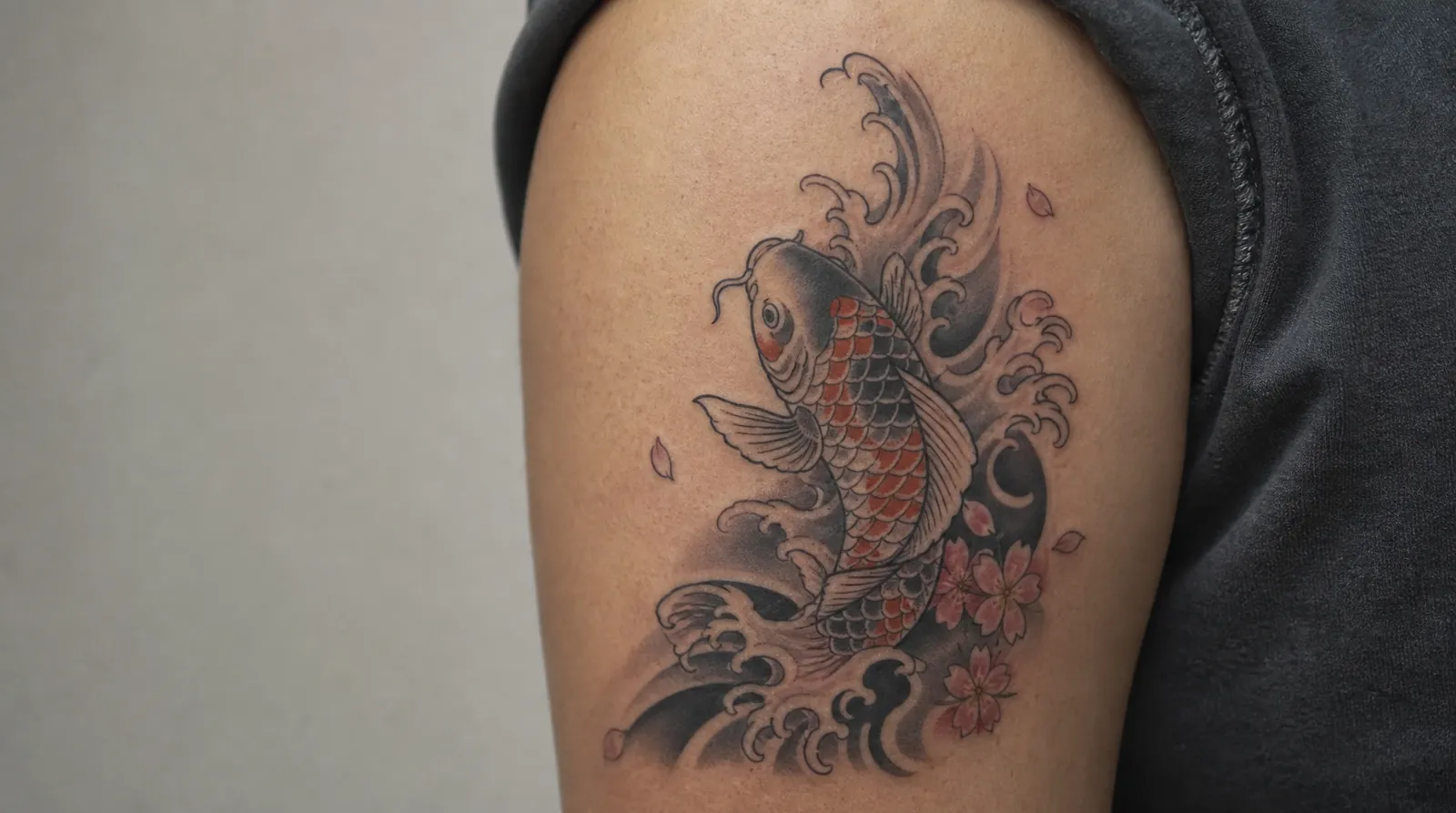
- Koi - perseverance. The legend has a koi swimming up a waterfall against the current and becoming a dragon, which is why an upstream koi is the classic symbol of pushing through hardship.
- Tiger - courage, and a ward against bad luck and disease.
- Snake - protection, change and rebirth.
- Cherry blossom (sakura) - the beauty and brevity of life. Blossoms falling are the point, not decoration around the edges.
The background is the style
What separates irezumi from a picture of a dragon is everything around the dragon. Wind bars, curling waves and stylised cloud fill the negative space and set the piece in motion, so the subject looks like it's moving through weather rather than floating on skin.
That background is also structural. It's what lets a full sleeve or back piece read as one composition instead of a collection of separate tattoos, and it's why the style is planned at scale - sleeves, back pieces, chest panels, thigh pieces. Traditional body suits are designed around the body's whole shape, often over years.
It's the reason a small isolated irezumi motif can feel like it's missing something. It usually is. A palm-sized dragon with nowhere to swim is Japanese-inspired rather than irezumi, which is a perfectly good thing to want - just name it accurately when you talk to an artist.
Designing an irezumi piece with AI
- Choose one hero subject and its background together: "a coiling dragon among stylised waves and clouds."
- Ask for the tradition explicitly: "Japanese irezumi style, bold outlines, traditional composition."
- Mention the body part so the flow curves correctly: "designed to wrap a full sleeve."
- Pick motifs whose meaning you actually want. This style's symbols are widely understood - a mismatch will be noticed.
- Treat the result as a direction, not a design. Bring it to a Japanese-style specialist who will rebuild the flow around your body.
Approaching the style respectfully
Irezumi is a living tradition with practitioners who train for years, and some still work tebori - hand-poked with a rod rather than a machine. Wearing it well mostly means engaging with it as a tradition rather than an aesthetic.
In practice that's simple. Learn what your motifs mean before you commit. Go to an artist who actually works in the style rather than asking a generalist to approximate it. And take seriously that a large Japanese piece carries associations in Japan that it doesn't carry elsewhere. None of that is a reason not to get one - it's the difference between wearing a tradition and wearing a costume.
Japanese (Irezumi) tattoos - FAQ
- Do Japanese tattoos have to be large?
- The traditional style is built for scale - sleeves, backs and thigh pieces - because the flowing background is half the design. Smaller single motifs absolutely work, but they read as Japanese-inspired rather than full irezumi, and it's worth naming that distinction with your artist.
- What does a koi fish tattoo mean?
- Perseverance and determination. The legend has a koi swimming up a waterfall against the current and transforming into a dragon, so an upstream koi is the classic symbol of pushing through hardship - one of the most enduring meanings in Japanese tattooing.
- Can I get a Japanese tattoo if I'm not Japanese?
- Japanese tattoo artists have taught and tattooed non-Japanese clients for decades, and the style has been practised worldwide for generations. What matters is the approach: understand what your motifs mean, go to someone who genuinely works in the style, and treat it as a tradition rather than a visual trend.
- Will tattoos stop me entering an onsen in Japan?
- Often, yes. Many onsen, public baths, gyms and pools still refuse entry to visibly tattooed guests because of the historical association with organised crime. Attitudes are slowly changing and some venues now allow covered or small tattoos, but check ahead rather than assuming.
- What is tebori?
- The traditional hand-poking method - ink applied with needles fixed to a rod, worked by hand rather than a machine. It's slower and produces a distinctive quality of shading that many collectors seek out specifically. Relatively few artists still offer it, so expect to travel and wait.
Related styles
Design a japanese (irezumi) tattoo now.
Describe your idea and get a clean, ready-to-ink design in seconds.
Start designing